Oakley Meta HSTN vs Ray-Ban Meta Gen 2 vs Gen 1: Which Smart Glasses Are Better?
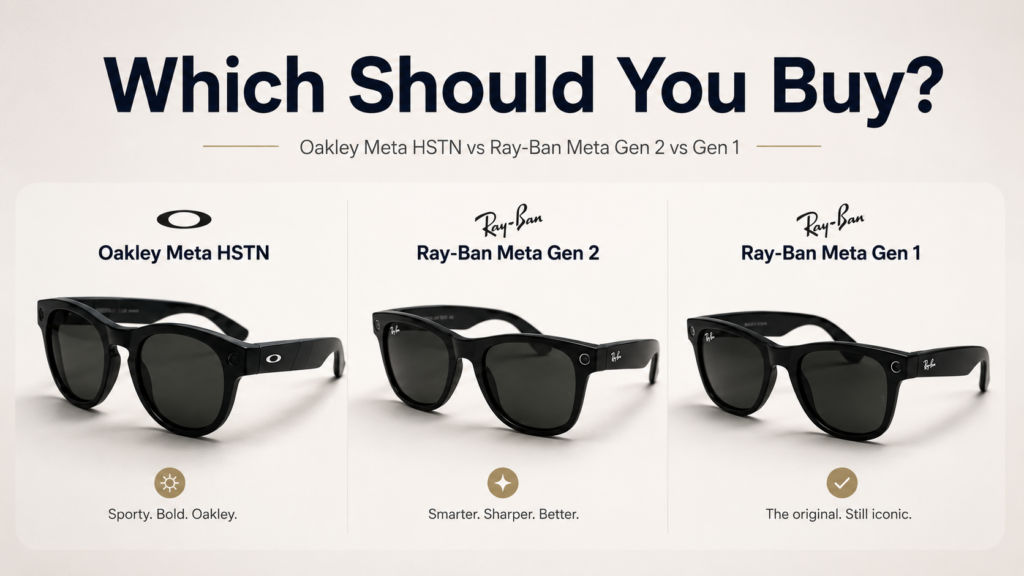
Choosing between the Oakley Meta HSTN, Ray-Ban Meta Wayfarer Gen 2, and Ray-Ban Meta Wayfarer Gen 1 is less about finding one universally superior pair and more about matching the frame, lenses, battery life, and camera system to how you will actually use them.
The Ray-Ban Meta Gen 2 is the safest all-around choice. It combines the familiar Wayfarer design with up to eight hours of moderate-use battery life and upgraded 3K video recording.
The Oakley Meta HSTN is the better outdoor and performance-oriented option, especially in this configuration with adaptive Transitions lenses. The Ray-Ban Meta Gen 1 remains the value option, but only when its current price is meaningfully lower than the newer models.
Affiliate disclosure: As an Amazon Associate, SmartViewHQ earns from qualifying purchases. This does not affect our reviews or recommendations.
Quick verdict
| Product | Best for | Main advantage | Main limitation |
|---|---|---|---|
| Ray-Ban Meta Wayfarer Gen 2 | Most everyday buyers | Classic styling, 3K video and eight-hour battery rating | This listing’s polarized lenses are less versatile indoors |
| Oakley Meta HSTN | Outdoor use, travel and active lifestyles | Sport-focused frame with adaptive Transitions lenses | Bolder styling will not suit every buyer |
| Ray-Ban Meta Wayfarer Gen 1 | Buyers prioritizing a lower purchase price | Similar core AI, camera and audio experience | Half the rated glasses battery life and lower video resolution |
Overall winner: Ray-Ban Meta Wayfarer Gen 2
Choose the Gen 2 Wayfarer when you want the strongest balance of discreet styling, camera quality, battery life and everyday usability.
Choose the Oakley Meta HSTN when outdoor versatility and a more performance-oriented frame matter more than understated styling.
Choose the Gen 1 Wayfarer only when its verified current price makes the battery and video compromises worthwhile.

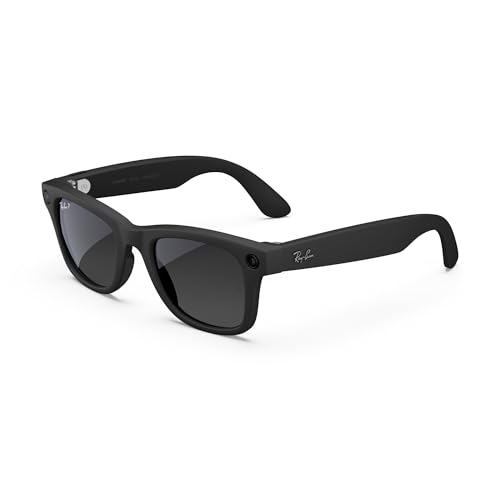

- [Check latest price for Oakley Meta HSTN on Amazon]
- [Check latest price for Ray-Ban Meta Gen 2 on Amazon]
- [Check latest price for Ray-Ban Meta Gen 1 on Amazon]
Oakley Meta HSTN vs Ray-Ban Meta: specifications
| Feature | Oakley Meta HSTN | Ray-Ban Meta Gen 2 | Ray-Ban Meta Gen 1 |
| Exact Amazon ASIN | B082KLQBD5 | B0FLYDWQDZ | B0DD65YPJV |
| Frame configuration | Clear Oakley HSTN | Matte Black Wayfarer | Matte Black Wayfarer |
| Included lenses | Transitions Grey | Polarized Gradient Graphite | Transitions Graphite Green |
| Camera | 12MP ultra-wide | 12MP ultra-wide | 12MP ultra-wide |
| Field of view | 100 degrees | 100 degrees | 100 degrees |
| Maximum listed video quality | Up to 3K | Up to 3K | 1080p+ |
| Rated glasses battery | Up to 8 hours of typical use | Up to 8 hours of moderate use | Up to 4 hours of moderate use |
| Charging-case capacity | Up to 48 additional hours | Up to 48 additional hours | Up to 32 additional hours |
| Audio | Open-ear speakers | Open-ear speakers | Open-ear speakers |
| Meta AI | Yes | Yes | Yes |
| Hands-free calls and messaging | Yes | Yes | Yes |
| Water resistance | IPX4 | IPX4 | IPX4 |
| Listed frame weight | 53.15g | 51.3g | Verify exact glasses-only weight |
| Best use case | Active and mixed indoor/outdoor use | Everyday wear and outdoor glare reduction | Lower-cost entry into Meta glasses |
The Oakley HSTN listing specifies a 12MP camera with a 100-degree field of view, video recording up to 3K, an eight-hour typical-use rating and up to 48 additional hours from the charging case. Its exact configuration uses Transitions Grey lenses and carries an IPX4 sweat-and-splash rating.
The exact Ray-Ban Gen 2 listing supplied here is the regular-size RW4012 Wayfarer with a matte black frame and polarized Gradient Graphite lenses. The listing gives a weight of 51.3g, while Ray-Ban specifies an upgraded 12MP camera, 3K video and up to eight hours of moderate use.
The Gen 1 Wayfarer uses the same listed 12MP, 100-degree camera format but is limited to 1080p+ video, up to four hours of moderate use and up to 32 additional charging hours from its case. The supplied listing includes Transitions Graphite Green lenses.
Battery figures are manufacturer estimates. Recording, calls, music streaming, AI requests, connectivity and environmental conditions can reduce real-world runtime.
Key differences at a glance
The three pairs share many of the same everyday functions. Each supports hands-free photos and video, open-ear audio, calls, messaging and Meta AI features.
The important differences are:
- Gen 1 has substantially shorter rated battery life.
- The two newer models support higher-resolution 3K video.
- Oakley and Ray-Ban use very different frame designs.
- The exact lens packages serve different environments.
- The Gen 1 only becomes compelling when the price gap is large enough.
Design and everyday wear
Ray-Ban Meta Gen 2: best understated design
The Wayfarer design is the easiest of the three to integrate into everyday clothing. It looks closer to conventional sunglasses than dedicated sports eyewear, making it better suited to commuting, travel, casual events and daily content capture.
The matte black finish is also relatively discreet. Buyers who want smart features without making the technology the focal point of their appearance will probably find the Gen 2 easier to wear regularly.
Its main design limitation comes from this specific lens configuration. Polarized Gradient Graphite lenses are intended for bright outdoor conditions and glare reduction. They do not become clear indoors like Transitions lenses.
Best for: Commuters, travelers, everyday creators and buyers who prefer classic sunglasses.
Oakley Meta HSTN: best active design
The HSTN takes a more performance-oriented approach. Its rounded Oakley frame is more visually distinctive than the Wayfarer and fits naturally with active, outdoor and sport-inspired clothing.
The clear frame and Transitions Grey lenses supplied in this listing make it more adaptable across changing light. The lenses darken in sunlight and return toward clear indoors, which can reduce the need to carry a separate pair of ordinary glasses or sunglasses.
The trade-off is styling. Buyers looking for the most discreet pair may find the Oakley shape and clear frame more noticeable.
Best for: Hiking, cycling breaks, travel days, outdoor events and buyers who move frequently between indoor and outdoor environments.
Ray-Ban Meta Gen 1: familiar style with older hardware
The Gen 1 uses the same general Wayfarer approach that makes the Gen 2 attractive for daily wear. Its Transitions Graphite Green lenses are also more adaptable indoors than the fixed polarized lenses included with the Gen 2 listing.
However, its shorter battery rating makes it less suitable for long travel days or frequent recording. The frame may look current, but the internal hardware creates a clearer compromise.
Best for: Casual use, occasional hands-free capture and buyers who find it at a significantly lower verified price.
Design winner: Ray-Ban Meta Gen 2
Lens-versatility winner: Oakley Meta HSTN
Camera and video quality
All three listings include a 12MP ultra-wide camera with a 100-degree field of view. That makes the resolution difference in video more important than the headline megapixel count.
Both the Oakley Meta HSTN and Ray-Ban Meta Gen 2 support video recording up to 3K. The Gen 1 is listed at 1080p+ resolution.
The higher resolution gives the newer glasses more room for:
- Capturing finer details
- Cropping footage during editing
- Recording travel and outdoor scenes
- Producing clearer first-person clips
- Preserving footage for larger screens
That does not mean every 3K clip will automatically look professional. Lighting, movement, camera positioning, compression and stabilization still affect the result. These glasses are most useful for spontaneous first-person footage rather than controlled cinematic production.
Camera winner: tie between Oakley Meta HSTN and Ray-Ban Meta Gen 2
Their listed camera and video specifications are closely matched. Choose between them based on frame design and lens type rather than expecting a dramatic camera advantage from one over the other.
Battery life and charging
Battery life is the clearest reason to avoid the Gen 1 unless it is heavily separated from the newer models on price.
Ray-Ban rates Gen 2 for up to eight hours of moderate use, compared with up to four hours for Gen 1. Ray-Ban also lists up to five hours of continuous audio and voice-assistant use for Gen 2 versus up to three hours for Gen 1.
Oakley similarly rates the HSTN for up to eight hours of typical use, up to five hours of continuous audio and up to 19 hours on standby.
The charging cases also favor the newer models:
| Model | Rated glasses use | Additional case charging |
| Oakley Meta HSTN | Up to 8 hours | Up to 48 hours |
| Ray-Ban Meta Gen 2 | Up to 8 hours | Up to 48 hours |
| Ray-Ban Meta Gen 1 | Up to 4 hours | Up to 32 hours |
People who record regularly, stream music or make calls will probably recharge more often than these maximum figures suggest.
Battery winner: tie between Oakley Meta HSTN and Ray-Ban Meta Gen 2
Both offer a much more practical foundation for regular use than Gen 1.
Lenses: polarized versus Transitions
The supplied links include three different lens configurations, and this may affect your decision as much as the electronics.
Oakley Meta HSTN: Transitions Grey
These lenses adapt to changing light, becoming darker outdoors and clearer indoors. This makes the Oakley configuration the most flexible option for all-day movement between environments.
It is the strongest choice when you want one wearable pair for travel, outdoor activities and indoor stops.
Ray-Ban Meta Gen 2: Polarized Gradient Graphite
Polarized lenses are designed to reduce reflected glare, which can be useful around roads, water and bright outdoor surfaces. The gradient tint can also provide a more conventional sunglass appearance.
However, they remain sunglasses. This exact configuration is therefore less convenient when you expect to wear the glasses for long periods indoors.
Ray-Ban Meta Gen 1: Transitions Graphite Green
The Gen 1 listing offers the same broad indoor-to-outdoor advantage as the Oakley configuration. It may be attractive to buyers who prefer the Wayfarer design but still want adaptive lenses.
The drawback is that choosing the Gen 1 for its lenses also means accepting the older battery and video system.
Lens winner: Oakley Meta HSTN
Its adaptive lens package and newer electronics create the best combination for mixed indoor and outdoor use.
Audio, calls and Meta AI
All three models provide open-ear audio, allowing users to hear music, podcasts, calls and voice responses without placing earbuds inside the ears. Ambient sound remains audible, which can be helpful for awareness but also means the glasses do not provide the isolation of noise-canceling headphones.
All three also support:
- Meta AI
- Hands-free calls
- Messaging
- Voice commands
- Live translation features
- Photo and video capture
- Adaptive volume
- Garmin and Strava integration
The Amazon comparison data lists these shared features across Gen 1, Gen 2 and Oakley HSTN.
Feature availability can vary by account, language, country and software version. A compatible smartphone, Meta account, internet access and the Meta AI app are required for setup and the full experience.
Smart-feature winner: tie
The newer hardware improves battery and video, but the fundamental Meta AI experience is broadly similar across the three.
Water resistance and outdoor limitations
All three models carry an IPX4 rating. That means they are positioned for sweat and splashes, not swimming or submersion.
Despite Oakley’s sport-focused design, the HSTN in this comparison is not a fully waterproof action camera. Use extra care around heavy rain, pools, ocean water and activities where the glasses could be submerged or dropped.
Durability winner: tie on published water resistance
Oakley looks more sport-oriented, but the listed IP rating is the same across these three products.
Product-by-product breakdown
Oakley Meta HSTN: best for outdoor versatility
The Oakley Meta HSTN is the most specialized option in this comparison. Its appeal comes from combining newer-generation Meta hardware with a recognizably Oakley frame and adaptive lenses.
What it does best
- Moves between indoor and outdoor conditions more easily
- Provides up to 3K first-person video
- Offers the longer eight-hour battery rating
- Fits active and sport-inspired use cases
- Includes a charging case rated for up to 48 additional hours
Where it falls short
- The rounded, clear frame is more noticeable than a black Wayfarer
- IPX4 does not make it suitable for swimming
- Buyers who prefer traditional sunglasses may not like the HSTN shape
- Exact comfort depends heavily on face shape and bridge fit
Oakley Meta HSTN pros and cons
| Pros | Cons |
| Adaptive Transitions lenses | Bold design is not for everyone |
| Eight-hour typical-use rating | Not submersible |
| Up to 3K video | May look less natural in formal settings |
| Strong outdoor use case | Fit should be checked carefully |
| 48-hour charging-case rating | Current price must be verified |
Verdict: Choose the Oakley Meta HSTN when you prioritize outdoor use, adaptive lenses and newer camera hardware over discreet styling.
Ray-Ban Meta Wayfarer Gen 2: best overall
The Gen 2 Wayfarer offers the most balanced package. It provides the newer battery and video system without moving away from the familiar Ray-Ban shape.
This exact configuration is particularly suitable for outdoor daily use because it includes polarized Gradient Graphite lenses.
What it does best
- Blends smart technology with a conventional Wayfarer design
- Doubles the manufacturer-rated moderate-use battery life of Gen 1
- Records video at up to 3K
- Reduces outdoor glare with polarized lenses
- Provides the safest balance for most buyers
Where it falls short
- The included lenses are not ideal for extended indoor wear
- It does not offer a major AI-feature advantage over Gen 1
- Buyers who already own Gen 1 may view it as an incremental upgrade
- The newer model may cost considerably more, depending on current listings
Ray-Ban Meta Gen 2 pros and cons
| Pros | Cons |
| Best all-around design | Fixed sunglass lenses in this configuration |
| Up to eight hours of moderate use | Price premium must be checked |
| Up to 3K video | Still only IPX4 |
| Polarized lenses | No visual display inside the lenses |
| 48-hour charging-case rating | Requires the Meta ecosystem |
Verdict: Choose the Ray-Ban Meta Gen 2 when you want the most practical mix of everyday styling, battery endurance and camera quality.
- #1 SELLING AI GLASSES* – Tap into iconic style and advanced technology with Ray-Ban Meta, the #1 selling AI glasses*. Ca…
- META AI – Get more done and stay connected without reaching for your phone with AI glasses powered by Meta AI. Capture v…
- OPEN-EAR AUDIO – Listen to music and more with discreet open-ear speakers that deliver rich, quality audio and Bluetooth…
Ray-Ban Meta Wayfarer Gen 1: best only at the right price
The Gen 1 still covers the core experience: hands-free photos, open-ear sound, calls, messages and Meta AI. It also retains the classic Wayfarer design and offers adaptive lenses in this listing.
Its problem is not a lack of features. It is the size of the battery and video-quality gap compared with the newer models.
What it does best
- Provides the main Meta smart-glasses experience
- Uses familiar Wayfarer styling
- Includes adaptable Transitions lenses
- May offer better value when discounted substantially
Where it falls short
- Rated for only up to four hours of moderate use
- Case offers fewer additional charging hours
- Video is limited to 1080p+
- Less suitable for long recording or travel days
- Value depends completely on the current price difference
Ray-Ban Meta Gen 1 pros and cons
| Pros | Cons |
| Familiar Wayfarer shape | Four-hour moderate-use rating |
| Transitions lenses | 1080p+ rather than 3K video |
| Similar core Meta AI features | Smaller charging-case capacity |
| Potential value option | Older hardware platform |
| Good for occasional use | Harder to recommend at a small price difference |
Verdict: Buy the Gen 1 only when its verified price is low enough to compensate for shorter battery life and lower video resolution.
- #1 SELLING AI GLASSES – Move effortlessly through life with Ray-Ban Meta glasses. Capture photos and videos, listen to m…
- CAPTURE WHAT YOU SEE AND HEAR HANDS-FREE – Capture exactly what you see and hear with an ultra-wide 12 MP camera and a f…
- LISTEN WITH OPEN-EAR AUDIO — Listen to music and more with discreet open-ear speakers that deliver rich, quality audio w…
Best choice by user type
| Buyer type | Best choice | Why |
| Most everyday buyers | Ray-Ban Meta Gen 2 | Best mix of style, battery and camera quality |
| Outdoor and active users | Oakley Meta HSTN | Performance styling and adaptive lenses |
| Travelers | Oakley Meta HSTN | Easier indoor-to-outdoor lens transition |
| Casual creators | Ray-Ban Meta Gen 2 | Discreet design with 3K recording |
| Outdoor content creators | Oakley Meta HSTN | 3K capture with a more active-use frame |
| Drivers and bright-light users | Ray-Ban Meta Gen 2 | Polarized lenses help manage reflected glare |
| Indoor and outdoor mixed use | Oakley Meta HSTN | Transitions lenses are more adaptable |
| Budget-focused buyers | Ray-Ban Meta Gen 1 | Worth considering only with a substantial price advantage |
| Existing Gen 1 owners | Keep Gen 1 or upgrade to Gen 2 | Upgrade mainly for battery and 3K video |
| First-time Meta glasses buyers | Ray-Ban Meta Gen 2 | Fewest major compromises |
Should Gen 1 owners upgrade?
An upgrade is most reasonable when battery life interrupts your current use or when you regularly record video.
Moving from the Gen 1 to either newer model increases the rated moderate-use battery from four hours to eight hours. It also raises maximum listed video quality from 1080p+ to 3K and expands charging-case capacity from 32 to 48 additional hours.
Upgrading is less urgent when you:
- Use the glasses only occasionally
- Mainly listen to short podcasts or make brief calls
- Rarely record video
- Are satisfied with the existing frame and lenses
- Do not want to pay for incremental hardware improvements
The Gen 2 is a practical upgrade, not a completely different category of device.
Which one should you buy?
Buy the Ray-Ban Meta Gen 2 when:
- You want the best overall balance
- You prefer classic Wayfarer styling
- Battery life is important
- You plan to record hands-free video
- You mainly wear sunglasses outdoors
- Polarized lenses suit your use
Buy the Oakley Meta HSTN when:
- You frequently move between indoor and outdoor environments
- You prefer an active Oakley design
- You want Transitions lenses
- You plan to use the glasses while traveling or outdoors
- You want newer battery and camera hardware
Buy the Ray-Ban Meta Gen 1 when:
- It is substantially less expensive at the time of purchase
- Four hours of rated use is enough
- You record video only occasionally
- You want adaptive lenses in a Wayfarer frame
- Cost matters more than long-session endurance
Final verdict
The Ray-Ban Meta Wayfarer Gen 2 is the best overall choice for most buyers. Its classic frame makes it easier to wear regularly, while its eight-hour moderate-use battery rating and 3K recording address the two clearest weaknesses of Gen 1.
The Oakley Meta HSTN is the smarter choice for active and mixed-environment use. Its Transitions Grey lenses are more versatile than the fixed polarized lenses included with the supplied Gen 2 Wayfarer listing.
The Ray-Ban Meta Gen 1 remains relevant as a value option, but only when its current price is far enough below the newer models. When the difference is modest, the longer battery life and higher video resolution of Gen 2 are more practical long-term advantages.
SmartView HQ recommendation:
- Best overall: Ray-Ban Meta Wayfarer Gen 2
- Best for outdoor versatility: Oakley Meta HSTN
- Best lower-cost option: Ray-Ban Meta Wayfarer Gen 1, subject to verified pricing
[Compare current options on Amazon]
Frequently asked questions
Is the Oakley Meta HSTN better than Ray-Ban Meta Gen 2?
Neither is universally better. Their core camera, battery, audio and AI specifications are closely matched. The Oakley is better for buyers who prefer its sport-focused frame and adaptive lenses. The Ray-Ban Gen 2 is better for buyers who want a classic everyday design.
Does Ray-Ban Meta Gen 2 have better battery life than Gen 1?
Yes. Ray-Ban lists up to eight hours of moderate use for Gen 2 and up to four hours for Gen 1. The Gen 2 charging case is also rated for up to 48 additional hours, compared with 32 hours for Gen 1.
Do the Oakley Meta HSTN and Ray-Ban Meta Gen 2 use the same camera?
Both are listed with a 12MP ultra-wide camera, 100-degree field of view and video recording up to 3K. Any practical differences may come from software processing, movement, lighting and how each frame sits on the wearer.
Are these Meta smart glasses waterproof?
No. All three are rated IPX4, which covers sweat and splashes but not swimming or submersion.
Can Ray-Ban Meta Gen 2 be worn indoors?
The glasses themselves can be used indoors, but the exact Gen 2 listing compared here includes polarized Gradient Graphite sunglass lenses. Buyers wanting easier indoor use should consider a clear or Transitions configuration.
Do Meta smart glasses have a display?
These three models focus on camera, audio, microphones and voice-based AI features. They do not place a conventional visual screen in front of the wearer’s eyes.
Do the glasses need a smartphone?
A compatible smartphone and the Meta AI app are required for setup and management. Meta also requires a valid account and internet access for the full feature set.
Is Ray-Ban Meta Gen 1 still worth buying?
It can still be worthwhile when the current price is substantially lower and you only expect occasional use. Gen 2 is generally the better long-term purchase for frequent recording, calls or audio because of its longer battery rating.